
Geysers, Boiling Groundwater and Tectonics: The 3D Subsurface Resistive Structure of the Haukadalur Hydrothermal Field, Iceland
Journal of Geophysical Research: Solid Earth
| 2022-11 | Journal article | DOI: 10.1029/2022JB024040
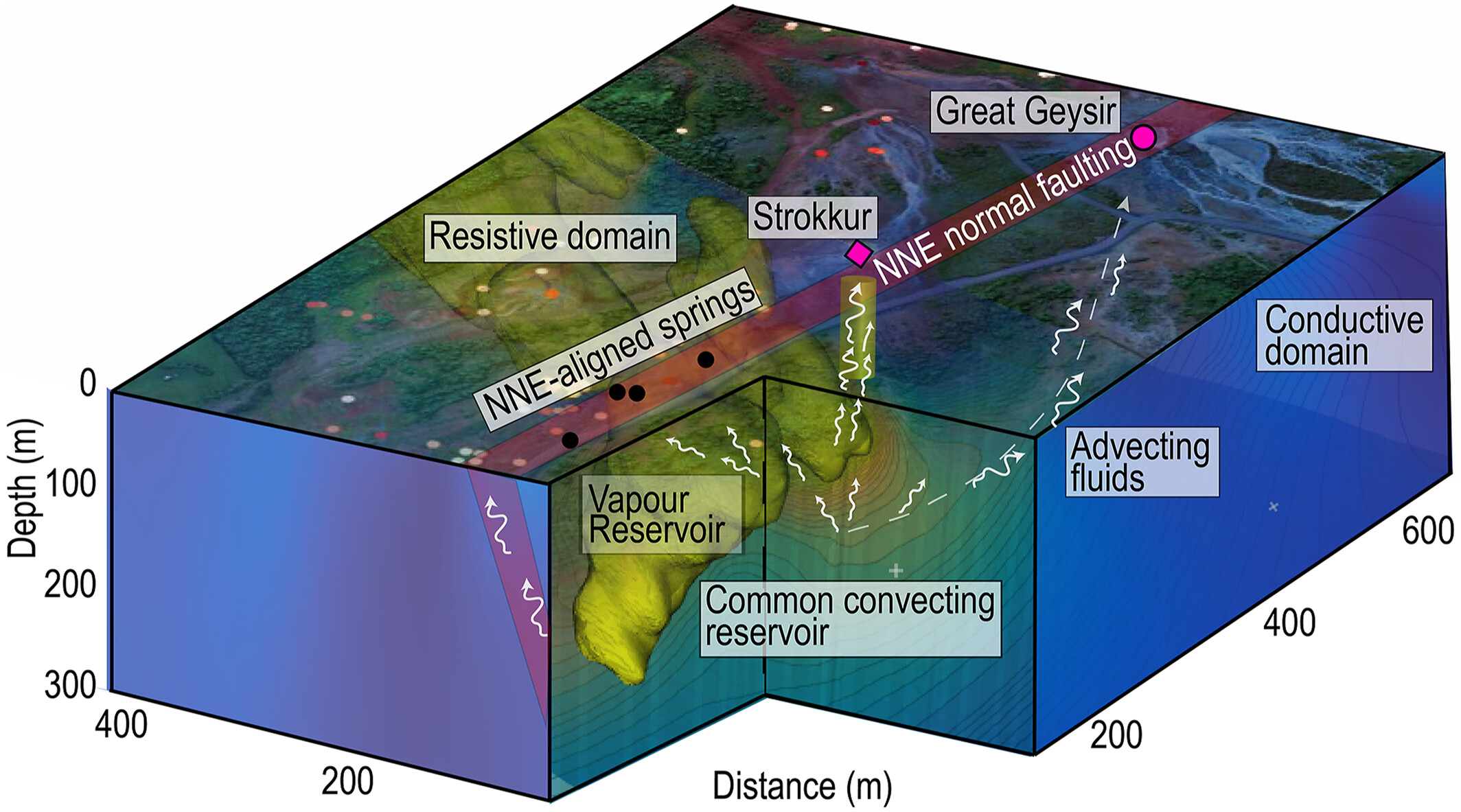
To shed light on the spatial relationships between the vertical conduits and the aquifers feeding them, we conducted a 3D geoelectrical campaign in the Haukadalur hydrothermal field, Iceland. By combining a semi-quantitative temperature distribution of the thermal springs across the hydrothermal field with the inversion of the geoelectrical data, we highlight the control that extensional tectonics have on the distribution of fluids across the hydrothermal field. Induced polarization data show that the geysers are fed by sub-vertical water-filled fracture zones. The geysers are found at the margins of highly resistive regions where we speculate boiling groundwater and vapor is found. Our proposed model suggests that local waters feeding the main groundwater reservoir downwell from the nearby region and then convect upwards, phase transitioning into vapor at about 200 m depth. From here, fluids flow toward the surface through pipes cutting a highly pressurized and hot system.
Credits
University of Geneva, Geostudi Astier srl