
Combining 3-D Deep Electrical Resistivity Tomography With Magnetic Surveys to Investigate Complex Tectonic Basins: A Case Study From the Central Apennines Seismic Belt (Italy)
Tectonics
| 2025-08 | Journal article | DOI: 10.1029/2024TC008716
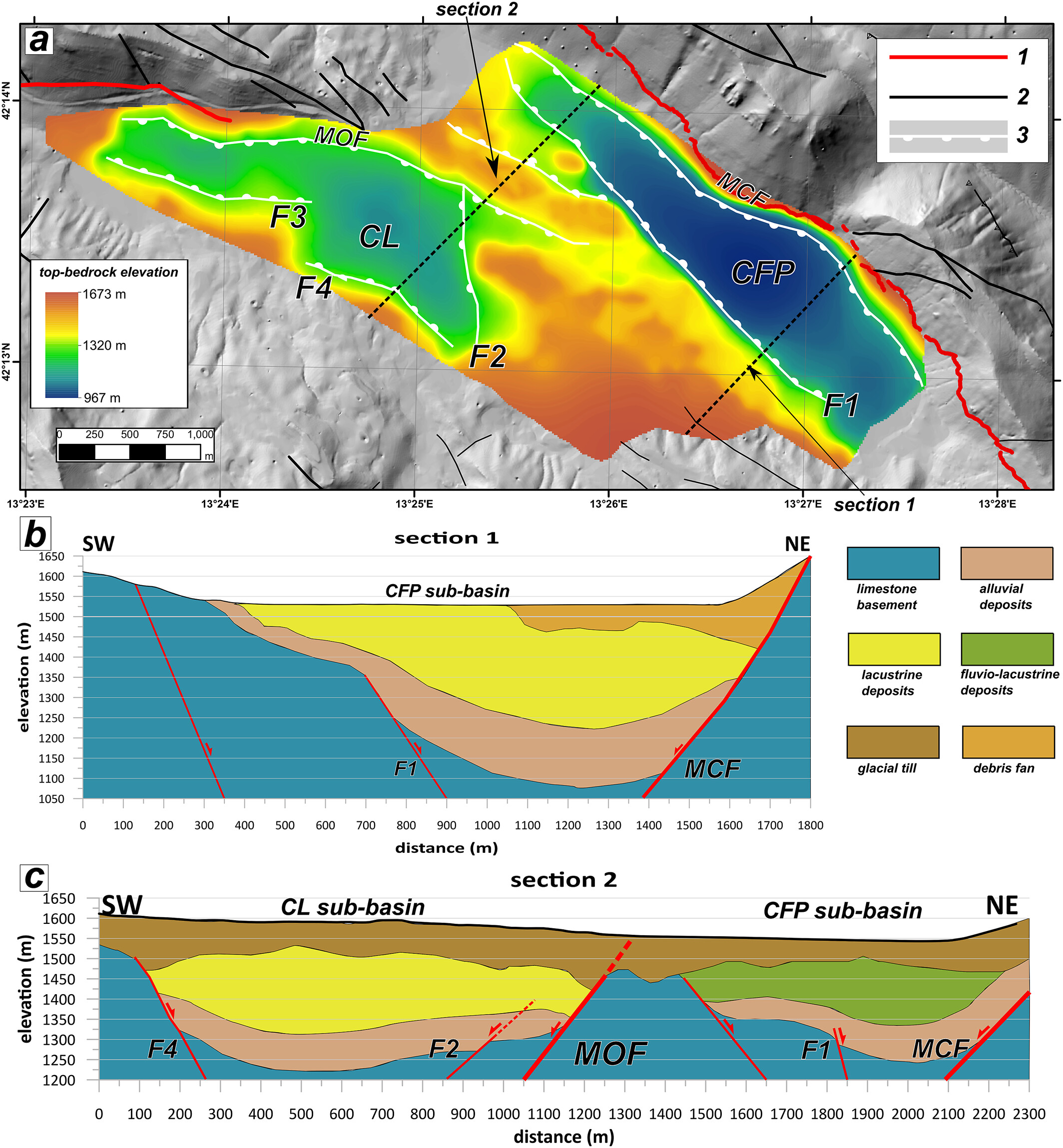
We use an innovative geophysical approach to reconstruct the deep structure of Campo Felice, an important extensional basin in the central Apennines (Italy) where active crustal extension is accommodated by normal faults capable of generating earthquakes of magnitude MW 6+. To this end, we combine 3-D Deep Electrical Resistivity Tomography with Unmanned Aerial Vehicle aeromagnetic survey. Before this study, the knowledge of the subsurface was limited to a small sector of the basin investigated by two seismic reflection profiles and shallow scientific drillings. Our resistivity model unravels for the first time a complex subsurface structure, due to two SW-dipping and left-stepping normal faults (Mt Cefalone-Serralunga and Mt Orsello), with antithetic and relay faults. Altogether, they favored the generation of two distinct sub-basins ∼400–450 and ∼250–300 m-deep, filled with alluvial, lacustrine and glacial deposits. Aeromagnetic data further constrain the extent and thickness of fine-grained infill sediments, while previous drillings and seismic reflection profiles are useful to constrain geological interpretation. We provide a model of basin evolution covering approximately the last million years, improving the knowledge of the Quaternary kinematics and structure of this sector of the chain. Furthermore, this cost-effective approach can be safely exported to similar tectonic contexts elsewhere.
Credits
INGV, University of Geneva, Geostudi Astier srl